Four Jobs, One Tube: The Uncomfortable Arithmetic of the 'Active' Tinted Moisturiser

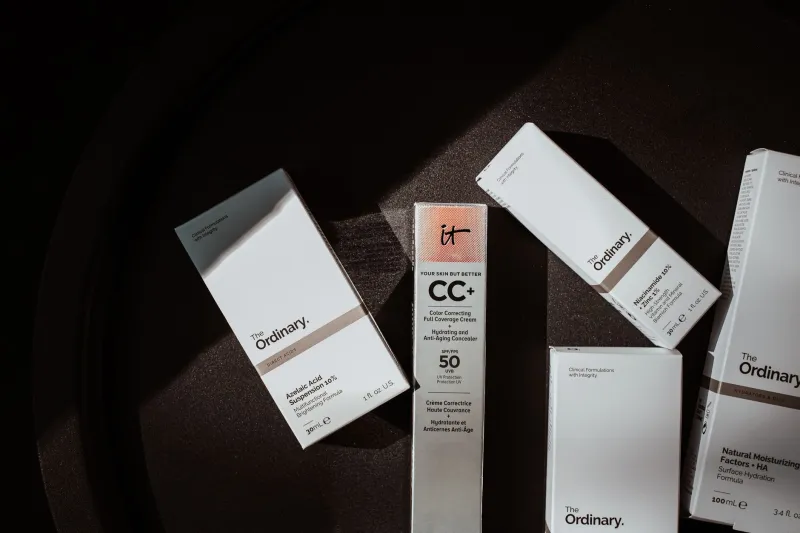
Photo: tinted moisturiser tube swatch on hand makeup flatlay, via static.wikia.nocookie.net
The hybrid category has grown up. What began as a tinted moisturiser with a token SPF has become, in 2026, a shelf of products promising skincare actives, sun protection, primer performance and foundation coverage in one 30ml tube. The language is borrowed wholesale from serums: barrier support, brightening, antioxidant defence. It is worth asking, calmly and without cynicism, how much of that survives the journey into a pigmented emulsion.
The ingredient list is a confession, if you read it properly
Cosmetic ingredient lists follow the INCI convention: components are ordered by concentration down to 1%, after which they may be listed in any order. That single rule explains most of what is puzzling about hybrids.
A tube that advertises niacinamide, hyaluronic acid and vitamin C may list all three below fragrance and below the preservative. That is entirely legal — "contains" claims require presence, not efficacy — and it is not dishonest, but it is not the same as a serum that delivers niacinamide at 4% or 5%, the range used in most of the published work on barrier function and sebum regulation.
Meanwhile, a genuinely protective SPF 30 requires a filter load in the region of 20–25% of the formula, and pigment dispersions for even sheer coverage typically run from 5% to 15%. Add emulsifiers, silicones, film-formers, thickeners and preservatives, and there is not a great deal of percentage left over. Something has to give, and the thing that gives is almost always the active.
The sunscreen maths nobody puts on the carton
SPF is measured in a laboratory at 2mg per square centimetre of skin. Real-world application studies consistently find that people use a fraction of that — often 0.5 to 1mg/cm² — which translates to a protection level far below the number on the tube.
Tinted products suffer a particular version of this problem, because there is a direct tension between protection and appearance. Applying enough tinted base to reach anything like an adequate film will usually look heavy, settle into lines and oxidise by mid-afternoon. Applying the amount that looks good delivers a small fraction of the stated SPF. The product is not failing; the category is being asked to do two jobs whose requirements pull in opposite directions.
One genuine advantage deserves credit: iron oxides in tinted formulas provide some protection against visible light, which matters for people managing melasma and post-inflammatory pigmentation. That benefit is real and increasingly well documented. It is not, however, a substitute for a dedicated sunscreen applied in proper quantity underneath.
Pigment and actives do not always coexist politely
An emulsion carrying iron oxides and titanium dioxide is a crowded place chemically. Pigments can adsorb actives onto their surfaces, reducing what actually reaches the skin. Low-pH actives such as L-ascorbic acid sit awkwardly alongside pigments and certain film-formers, where colour drift and emulsion instability become real formulation problems over a product's shelf life.
Retinol in a daytime tinted base is, frankly, a claims decision rather than a clinical one: it is light- and oxygen-sensitive, and a product worn outdoors all day is an inefficient delivery vehicle. If a tube lists retinol, treat it as a pleasant extra rather than your retinoid step.
The layering conflicts
Pilling is the most common complaint about hybrids, and it is usually a layering problem rather than a formula fault. A silicone- and gum-heavy tinted base applied over a water-rich serum with a high humectant load will ball up under a brush. The fix is mechanical: give each layer sixty seconds, apply the hybrid with fingers or a damp sponge rather than a buffing brush, and use fewer products underneath, not more.
Stacking is the other trap. A hybrid containing niacinamide, worn over an acid toner, under a vitamin C serum, with a separate exfoliant three nights a week, is not a streamlined routine — it is an unmonitored one. If a product's active content is unknown, the sensible assumption is that it is modest and that your dedicated serum is doing the real work.
What hybrids are genuinely good at
This is not an argument for writing off the category. Modern hybrids are better textured, better shade-ranged and better formulated than their predecessors. They excel as light-coverage makeup with a pleasant, emollient feel and a modest photoprotective bonus. For a low-effort weekend, a gym-to-coffee morning or a day at a desk away from windows, they are genuinely efficient.
Where they struggle is when they are asked to replace four steps. The question to ask is not "does it contain it?" but "does it contain enough of it, and am I using enough of the product for the claim to hold?"
An honest routine around a hybrid
- Morning: a dedicated serum at a concentration you can actually verify, applied thinly and given time to settle.
- Sunscreen: a separate, cosmetically acceptable SPF at the full two-finger quantity. Every day, including November.
- Coverage: the hybrid, applied for appearance rather than for protection.
- Evening: cleanse properly. A pigmented, film-forming base needs a proper first cleanse, and a hybrid will not remove itself.
A short buying checklist
Read the ingredient list and locate the actives. Check where fragrance sits. Look for the PAO symbol and the UVA circle on the SPF rating. Note whether the brand states a filter percentage, and be sceptical of a very high SPF in a very sheer formula. Patch test, because tinted emulsions with high silicone loads are a common trigger for congestion in oily UK skin types through winter.
The hybrid is a good product in the right slot. It is simply not four products, and the routine that treats it as one will always be a little short of what it promised.