The Borrowed Routine: Auditing UK Scalp Serums Through a Facial Formulator’s Lens
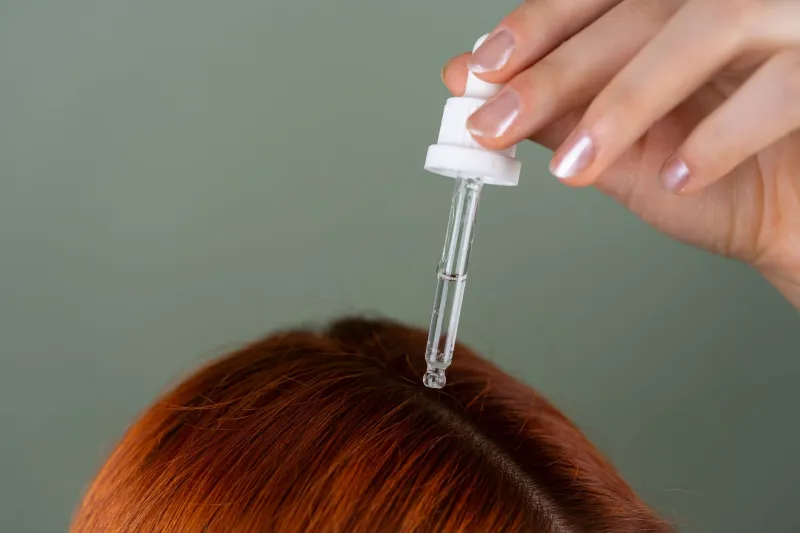
The scalp serum has become a familiar sight on the UK shelf. It sits beside dry shampoo in Boots, appears in the minimalist ranges at Space NK and is increasingly merchandised as a facial-style step: apply, massage, leave in. The vocabulary is familiar too. Niacinamide, salicylic acid, hyaluronic acid and peptides now appear on scalp cartons with the same confidence once reserved for face serums. The question for 2026 is not whether the category exists, but whether the formulation logic travels intact from the hairline upwards.
The same words, a different terrain
A scalp serum is not a facial serum in a taller bottle. The scalp has a dense follicular population, a rich supply of sebaceous glands and a stratum corneum that varies across the head. Hair also changes the practicalities of application: product must be parted through strands, massaged across skin and left in place without leaving a visible film. That alone shapes the vehicle. Facial serums can afford to be light and quickly absorbed; scalp serums often need slightly more slip and a residue profile that will not compromise styling.
This is where marketing language can outrun formulation reality. A product may contain the same named active as a facial serum, but at a different concentration and in a vehicle designed for a different purpose. The presence of an ingredient is not the same as a meaningful dose, nor is a familiar name proof of a comparable effect. In the UK, cosmetic claims must be capable of substantiation, but the label does not have to disclose the concentration of every active. That leaves the buyer to read the formula as a whole rather than shop by headline.
Humectants: the most reliable transfer
Hyaluronic acid and glycerin are the least contentious borrowings. They are humectants: they attract and hold water at the skin’s surface. On the scalp, as on the face, this can improve the feel of dryness and tightness, particularly in winter or in centrally heated homes. The effect is surface-level and temporary, which is not a criticism so much as a limit. A scalp serum containing glycerin, panthenol or hyaluronic acid can be a reasonable comfort product for a dry-feeling scalp, especially if it is fragrance-free and easy to rinse or leave without buildup.
The caveat is accumulation. Leave-on scalp products are applied repeatedly between washes. Film-formers, heavy oils and high levels of humectants can create buildup that mimics flaking or irritation. A facial serum is usually removed or followed by moisturiser; a scalp serum may sit under hair for days. For that reason, a simple humectant-led formula is often more persuasive than a crowded one.
Niacinamide: useful, but not a scalp-specific miracle
Niacinamide has become the most borrowed facial active in the scalp category. It supports the skin barrier and can help regulate sebum in some formulations. Those properties are relevant to the scalp, which is prone to oiliness and sensitivity for many people. But the evidence is largely drawn from facial skin, and the scalp is not simply a different address for the same biology.
Formulators also face a practical ceiling. Niacinamide is generally well tolerated, but higher concentrations can sting or irritate sensitive skin, and the scalp is not immune to that. A well-built scalp serum may use a modest percentage alongside soothing agents rather than chasing a ten per cent headline. When a UK product leads with a niacinamide percentage, the sensible question is whether the rest of the formula supports it: is there a sensitiser-heavy fragrance? Does the vehicle leave a tacky residue? Does the claim promise oil control that a leave-on cosmetic cannot reliably deliver? The number alone is not the answer.
Salicylic acid and the leave-on question
Salicylic acid is another facial import, often used in scalp serums aimed at flaking or oiliness. Here the distinction between rinse-off and leave-on matters enormously. A salicylic acid shampoo is rinsed away after a few minutes; a leave-on scalp serum remains in contact with skin for much longer. UK cosmetic rules and responsible formulation practice both demand that the leave-on product be designed for that exposure.
That does not make salicylic acid scalp serums invalid. It does mean the buyer should be cautious about daily use, especially on broken or highly reactive skin, and should not assume that a facial acid routine can be transferred wholesale to the head. If a product is marketed for flaking, it is worth checking whether the claim is cosmetic comfort or a medical one. Persistent scaling, itching or inflammation deserves a pharmacist or GP conversation rather than another serum.
Peptides and the evidence gap
Peptides are the most aspirational borrowing. They appear in scalp serums with language about density, strength and the follicle environment. Some peptides have plausible roles in skin biology, but the evidence for cosmetic scalp benefits is thinner than the marketing suggests. Hair growth is a regulated and medical territory in the UK; a cosmetic serum cannot promise to treat hair loss. It can, at most, support the appearance and condition of the scalp.
That is not to dismiss peptides outright. They can be part of a pleasant, well-textured formula, and some consumers find such products improve the feel of the scalp. But a peptide name on a carton is not a guarantee of follicular delivery or measurable hair change. Large molecules face real barriers, and the follicle is not an open pipe. The claim should be read as cosmetic care, not as a clinical intervention.
A practical audit for the UK shelf
A sensible 2026 approach is to judge scalp serums by function rather than by borrowed vocabulary. First, identify the problem: dryness, oiliness, flaking, sensitivity or simply the desire for a pleasant massage. Second, check the vehicle: will it sit comfortably under hair, or will it build up? Third, look for a short, fragrance-free formula if the scalp is reactive. Fourth, treat percentages as context, not proof. Finally, be sceptical of any product that implies a facial active will behave identically above the hairline.
The scalp-face divide is real, but it is not a wall. Humectants, niacinamide and well-chosen soothing agents can make a credible transfer. Acids and peptides require more caution and more honest claims. In 2026, the best scalp serums will not be the ones that shout the loudest about facial ingredients. They will be the ones that respect the scalp’s different terrain and ask the buyer to do the same.